Saturday, February 1, 2014

Hello, Citizens of 2057!

An excerpt from Mark Mazzetti's 1-7-14 New York Times article entitled "Burglars Who Took On FBI Abandon Shadows":

The perfect crime is far easier to pull off when nobody is watching.

So on a night nearly 43 years ago, while Muhammad Ali and Joe Frazier bludgeoned each other over 15 rounds in a televised title bout viewed by millions around the world, burglars took a lock pick and a crowbar and broke into a Federal Bureau of Investigation office in a suburb of Philadelphia, making off with nearly every document inside.

They were never caught, and the stolen documents that they mailed anonymously to newspaper reporters were the first trickle of what would become a flood of revelations about extensive spying and dirty-tricks operations by the F.B.I. against dissident groups.

The burglary in Media, Pa., on March 8, 1971, is a historical echo today, as disclosures by the former National Security Agency contractor Edward J. Snowden have cast another unflattering light on government spying and opened a national debate about the proper limits of government surveillance. The burglars had, until now, maintained a vow of silence about their roles in the operation. They were content in knowing that their actions had dealt the first significant blow to an institution that had amassed enormous power and prestige during J. Edgar Hoover’s lengthy tenure as director.

Skipping down further in the article we read:

…the document that would have the biggest impact on reining in the F.B.I.’s domestic spying activities was an internal routing slip, dated 1968, bearing a mysterious word: Cointelpro.

Neither the Media burglars nor the reporters who received the documents understood the meaning of the term, and it was not until several years later, when the NBC News reporter Carl Stern obtained more files from the F.B.I. under the Freedom of Information Act, that the contours of Cointelpro — shorthand for Counterintelligence Program — were revealed.

Since 1956, the F.B.I. had carried out an expansive campaign to spy on civil rights leaders, political organizers and suspected Communists, and had tried to sow distrust among protest groups. Among the grim litany of revelations was a blackmail letter F.B.I. agents had sent anonymously to the Rev. Dr. Martin Luther King Jr., threatening to expose his extramarital affairs if he did not commit suicide.

“It wasn’t just spying on Americans,” said Loch K. Johnson, a professor of public and international affairs at the University of Georgia who was an aide to Senator Frank Church, Democrat of Idaho. “The intent of Cointelpro was to destroy lives and ruin reputations.”

Senator Church's investigation in the mid-1970s revealed still more about the extent of decades of F.B.I. abuses, and led to greater congressional oversight of the F.B.I. and other American intelligence agencies. The Church Committee’s final report about the domestic surveillance was blunt. “Too many people have been spied upon by too many government agencies, and too much information has been collected,” it read.

As the New York Times celebrates these 43-year-old revelations of government malfeasance, one wonders how long it will take for the full extent of our present day domestic surveillance operations to be unveiled as well.  43 years from now, in 2057, will the New York Times--or its futuristic equivalent--be publishing articles about those dim, dark days when every single U.S. citizen was at the mercy of a fully operational gangstalking program, the existence of which few mainstream authorities were even willing to acknowledge publicly?

As Marshall McLuhan wrote in his 1972 book, Take Today:  The Executive as Dropout:  "Only puny secrets need protection.  Big discoveries are protected by public incredulity."

To read the entire New York Times article, click HERE.

Wednesday, January 29, 2014

Homeland Security Drone Crashes Off the Coast of San Diego

Echoes of my Fortean Times article, "Strange Tales of Homeland Security," continue to resonate in mainstream news reports. For example, see Alicia Caldwell's 1-28-14 Associated Press article about a Homeland Security drone that crashed into the Pacific Ocean--significantly, just off the coast of San Diego--after developing unknown mechanical problems. One of the main focuses of my FT article, of course, was the inextricable link between roving surveillance drones and the intelligence milieu that fuels the infrastructure of San Diego. To read Caldwell's entire article, click HERE.  

Tuesday, January 28, 2014

The Eighth Tower

Speaking of John A. Keel... his classic 1975 book, The Eighth Tower, has now been republished by Anomalist Books.  Loren Coleman, Keel's friend and colleague, writes about this long overdue event in a recent blog entry entitled "UFO Name Game Hits Shootings" in which he applies Keel's study of "name selectivity" to the spate of mass shootings now plaguing the U.S.  You can read Coleman's analysis HERE, and you can order The Eighth Tower HERE. 

Sunday, January 26, 2014

John A. Keel on Gangstalking

A correspondent has alerted me to several intriguing documents that can be found on a website devoted to the research of the late journalist, John A. Keel, who was without a doubt the preeminent investigator of the paranormal in the 20th century.  If you’ve read my recent Fortean Times article, “Strange Tales of Homeland Security” (in the Sep. 2013 edition of FT), you might wonder when the phenomenon known as “gangstalking” actually began.  Some researchers speculate that the harassment techniques we now associate with organized gangstalking can be traced back to the heinous activities of the Ku Klux Klan just after the Civil War.  Others claim that the National Security lockdown mentality that emerged in the aftermath of 9/11 led to the out of control gangstalking now threatening (or, in far too many cases, outright eliminating) our freedoms.  Of course, at this point one can’t be certain of the phenomenon’s true origins; however, it appears that such organized harassment was indeed operative at least as far back as the 1960s and ‘70s when John A. Keel was at the peak of his investigative prowess.  By clicking HERE and HERE, you will see Keel’s notes on a phenomenon that certainly bears an eerie resemblance to what we now know as “gangstalking.”  It’s interesting to note that these documents also serve as evidence of Keel’s meticulousness as a researcher of cryptoscatological subjects. 


Friday, January 17, 2014

Captain America Meets Big Brother

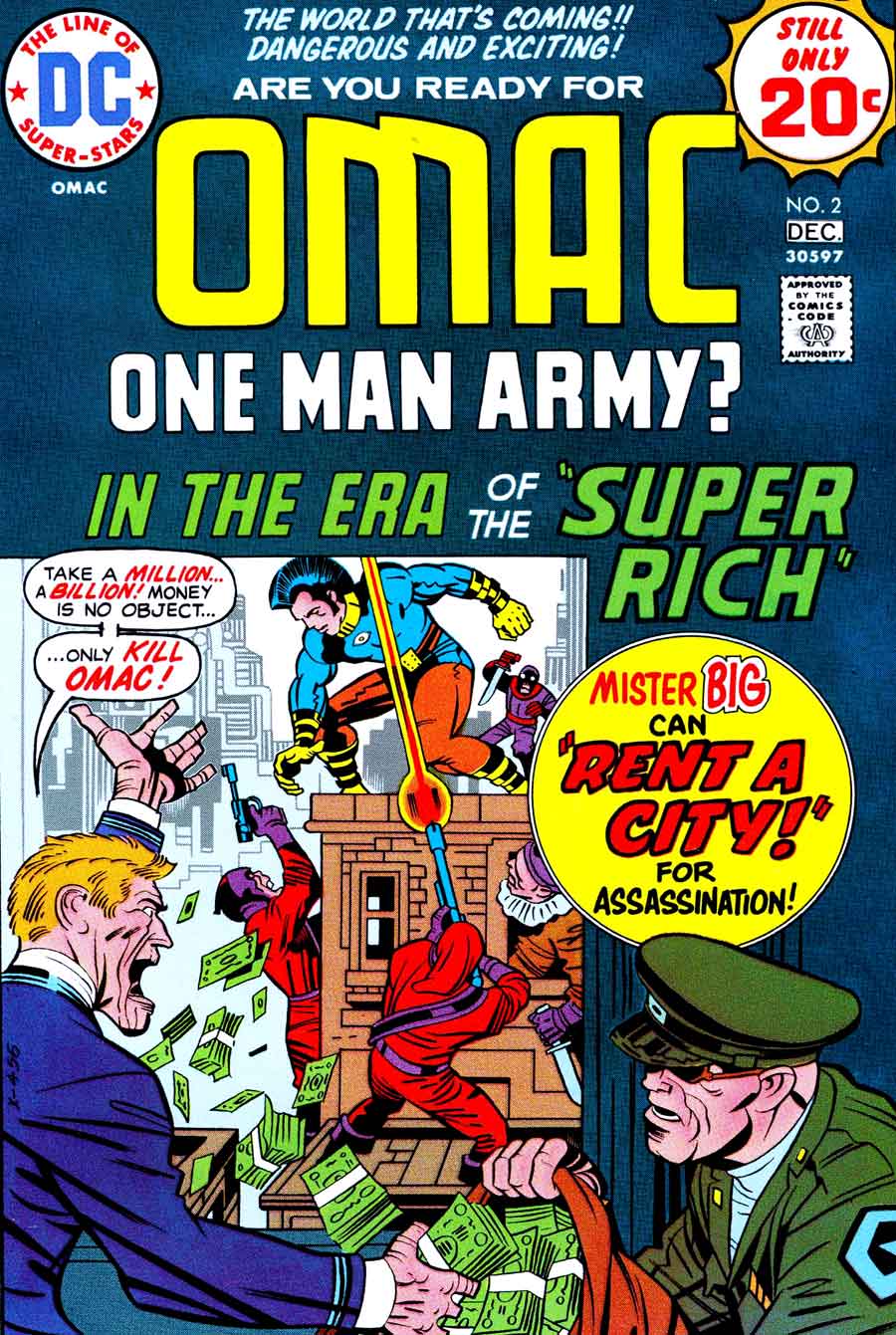
My article entitled "Captain America Meets Big Brother," which analyzes the prescient qualities of Jack Kirby's 1970s science fiction comic book OMAC, can be found in the latest issue of John Morrow's excellent magazine, The Jack Kirby Collector (#62).  Kirby's OMAC was a short-lived dystopian comic book series about Buddy Blank, an employee of a multinational corporation called Pseudo-People, Inc., who is chosen by the Global Peace Agency to undergo an experiment that transforms him into a superhuman One Man Army Corps (hence the acronym, "O.M.A.C.").  A scientist named Dr. Myron Forest performs "electronic surgery" on Mr. Blank, which succeeds in connecting Blank, body and soul, with a sentient orbiting satellite known as Brother Eye.  The intimidating symbol on OMAC's chest is the all-seeing eye, symbolizing the fact that a target, once chosen, cannot easily escape OMAC's field of vision.

https://blogger.googleusercontent.com/img/b/R29vZ2xl/AVvXsEjn8QtkczhbR699hMmz5srdRpODaXBYo3igyb_kJKjk2aWcKHkUMRKpGHChK0KwPlbhaHD9HVcPU_qjJAwTDSVUcavDBBWdGx02eKbb7ip4SUpFrDj95gqwZxeUfx0Y17YomojzRUt9Dts/s1600/Omac-v1-2-1-Im0.jpg

This darkly humorous superhero saga accurately anticipates the effects of such present day technological trends as "smart bombs" (yes, that's actually what Kirby calls them in the comic book), virtual reality entertainment devices, reconnaissance satellites, genetic and social engineering run amok, and even fantasy sex dolls.  If you're interested in learning more about Kirby's uncanny prognosticative talents, then I urge you to read "Captain America Meets Big Brother."  Simply click HERE to order a copy of The Jack Kirby Collector #62.    

http://www.previewsworld.com/catalogimages/STK_IMAGES/STK620001-640000/STK623483.jpg


Thursday, January 16, 2014

Questioning the Edward Snowden Story

As far as I can tell, Jon Rappoport is the only American journalist asking the right questions about the ongoing Edward Snowden controversy.  To understand what I mean, simply click HERE and read Rappoport's 1-15-14 article entitled "The 36 Mysterious Days of Edward Snowden."

Wednesday, January 15, 2014

Hollywood and the CIA

In Chapter Five of Cryptoscatology I touched on the intersection between Hollywood and the Central Intelligence Agency.  This same intersection is the subject of Ken Dilanian's 1-10-14 Los Angeles Times article entitled "Hollywood Figures Spied for CIA, Book Asserts."  What follows is a brief excerpt: 

"It’s well known that Hollywood loves a good spy story. But what is also true, according to a new memoir by a former senior CIA official, is that movie makers regularly do some real-life spying.

"'The CIA has long had a special relationship with the entertainment industry, devoting considerable attention to fostering relationships with Hollywood movers and shakers—studio executives, producers, directors, big-name actors,' John Rizzo, the former acting CIA general counsel, wrote in his new book, Company Man: Thirty Years of Crisis and Controversy in the CIA.

"People might assume that since Hollywood leans to the political left, the CIA’s relationships 'would be with the sort of conservative picket of Hollywood,' Rizzo said in an interview. 'Well, that’s not true.  People one would normally associated with liberal causes have assisted CIA.'

"Alas, Rizzo is prohibited from naming names. They are classified. The CIA declined to comment.

"He did, however, provide some detail about the types of help the agency has solicited from Hollywood. At times, Rizzo said, film makers will be asked to allow a CIA operative to pose as a member of their crew, particularly if a movie is being filmed in a country where the spy agency has difficulty operating.

"The CIA also recruits actors to give more visibility to propaganda projects abroad, such as a documentary secretly produced by the agency, Rizzo said. And the agency sometimes takes advantage of the door-opening cachet that movie stars and other American celebrities enjoy. A star who met a world leader, for example, might be asked for details about that meeting.

"The CIA has officials assigned full time to the care and feeding of Hollywood assets, Rizzo wrote.  Other former CIA officials added that some of those operatives work in the Los Angeles office of an agency department called the National Resources Division, which recruits people in the U.S. to help America spy abroad.

"'It was going on when I got there, and it was going on when I left,' in 2009, Rizzo said, adding that the activities continue."

The entire article can be read HERE.